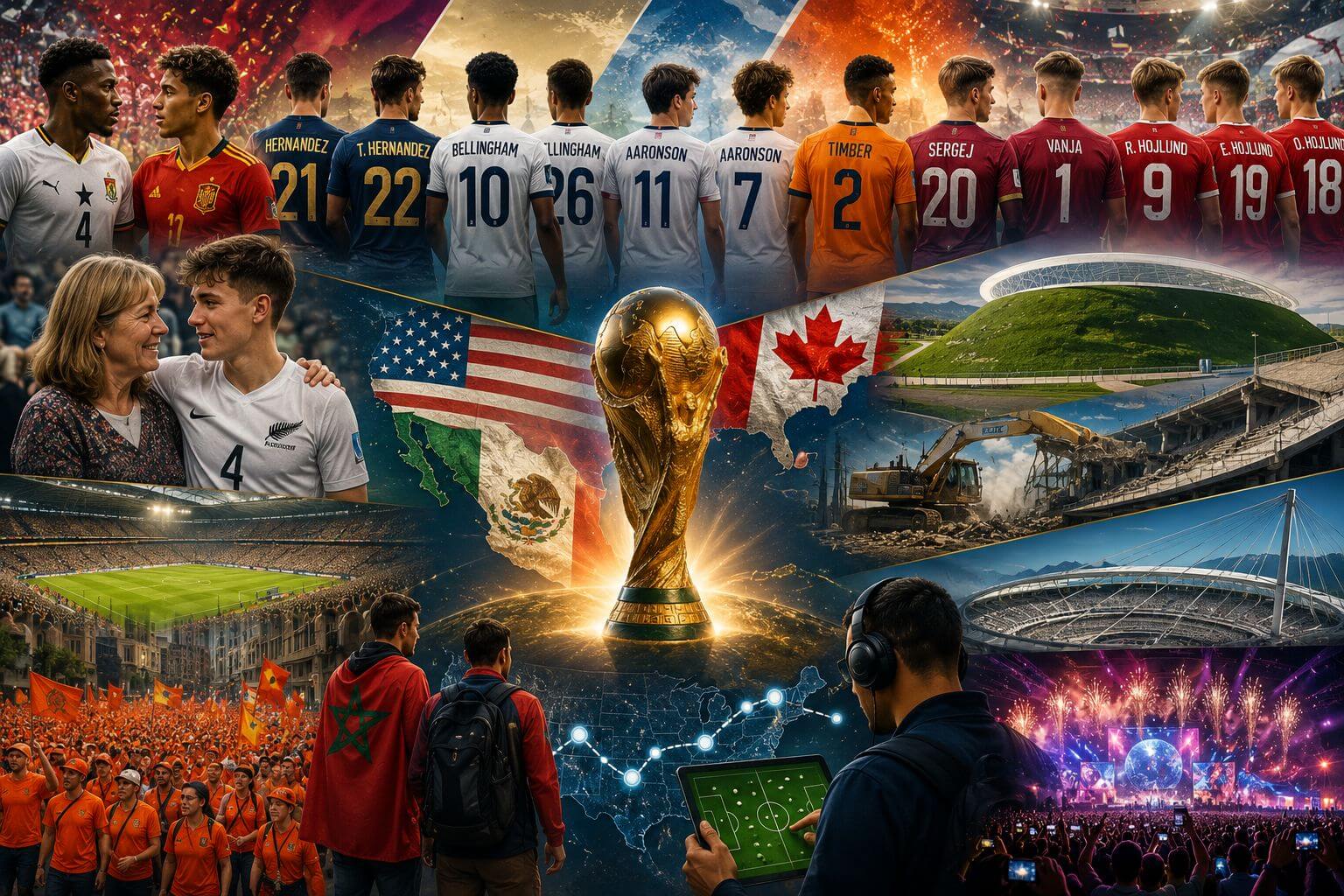
The 2026 FIFA World Cup has completely rewritten the soccer playbook. Expanding to a massive 48-team format spread across the United States, Mexico, and Canada, it is officially the biggest sports party on earth.
While the action on the pitch keeps everyone glued to their seats, the most unbelievable stories are happening in the stands, behind hotel doors, and inside the stadium blueprints. Here is a breakdown of the wildest secrets defining the tournament right now.
Sibling Rivalries and Split Allegiances
This tournament features an extraordinary collection of brotherhoods, showcasing the ultimate test of family loyalty under the bright lights of global soccer.
The Williams Brothers (Spain and Ghana)
Inaki Williams represents Ghana, while his younger brother Nico Williams plays for Spain. Born to Ghanaian parents who crossed the desert to reach Europe, the brothers chose different national paths, forcing their family to split their cheers across two completely different continents.
The Hernandez Brothers (France)
Lucas Hernandez and Theo Hernandez continue their family dominance with the French national team. Unlike split households, these two dynamic full-backs share the exact same badge and locker room.
The Bellingham Brothers (England)
Jude Bellingham is joined at the international level by his younger brother Jobe Bellingham. The two midfield powerhouses represent the future of English football, sharing a single nation’s dreams.
The Aaronson Brothers (United States)
Christian Aaronson and Paxten Aaronson bring home-field energy to the United States roster. Growing up in New Jersey, the two creative attackers now share the pitch together as co-hosts.
The Timber Brothers (Netherlands)
Jurrien Timber and Quinten Timber suit up together for the Dutch national team. The twins represent a rare defensive and midfield partnership anchoring the orange backline.
The Milinkovic-Savic Brothers (Serbia)
Sergej Milinkovic-Savic dominates the midfield while his brother Vanja Milinkovic-Savic protects the net as goalkeeper, locking down the spine of the Serbian squad.
The Hojlund Pairs (Denmark)
Rasmus Hojlund leads the attack for Denmark, while his younger twin brothers, Emil and Oscar Hojlund, represent the next generation looking to link up with their older sibling on the global stage.
A Rare Mother-Son Legacy
While the 2026 tournament is strictly a men’s competition, a unique family milestone connects two different generations of global FIFA play.
Young defender Tyler Bindon earned his spot on the New Zealand men’s national team roster for the 2026 World Cup. His mother, Jenny Bindon, is a legendary former goalkeeper who played every minute for the New Zealand Football Ferns at the 2007 and 2011 FIFA Women’s World Cups.
This rare cross-tournament connection marks the first time a mother and son have both represented New Zealand at senior FIFA World Cup events.
Bizarre Stadium Secrets and Concrete Demolitions
The 16 stadiums chosen for this tournament are beautiful architectural landmarks, but fitting a world-class soccer pitch into them required some truly extreme renovations.
Tearing Down Concrete
Many of the high-end venues in the United States were built strictly for American football, which uses a much narrower field. To satisfy strict FIFA pitch dimensions, stadiums like the one in Los Angeles literally had to demolish entire lower rows of permanent concrete seating just to clear enough physical space.
The Grass-Covered Volcano
Estadio Guadalajara in Mexico features one of the most stunning designs in global sports. The entire structure is built into a massive, man-made hill covered in lush green grass, making the venue look exactly like a sleeping volcano. Only its white, 360-degree roof rises above the landscape.
The Legendary Triple Crown
Mexico City Stadium (Estadio Azteca) has broken world records by becoming the first venue in history to host opening matches at three separate World Cup tournaments (1970, 1986, and 2026).
Gigantic Cable Ceilings
Up north, BC Place Vancouver boasts the absolute largest cable-supported retractable roof on the planet, allowing matches to pivot from open-air to indoor comfort in mere minutes.
Smashed Records and Moving Cities
With 104 matches on the schedule, millions of fans are traveling across North America, creating unbelievable logistical puzzles and unforgettable atmospheres.
A 32-Year-Old Turnstile Record Smashed
The tournament set a historic single-day attendance record when over 281,000 fans passed through stadium gates on a single afternoon, completely shattering the previous single-day high-water mark that had stood since 1994.
The 1,400-Mile Travel Nightmare
Because groups are not geographically locked, some fan bases are facing brutal itineraries. For instance, Morocco supporters had to travel from New Jersey up to Boston, and then all the way down to Atlanta—covering nearly 1,450 miles across three matches.
The Bright Orange Invasion
In Kansas City, tens of thousands of Dutch fans dressed in head-to-toe bright orange completely blocked traffic for miles as they marched together through the city streets before kick-off.
Non-Ground Innovations and High-Tech Fun
Technology and accessibility have reached entirely new heights for this tournament cycle.
Haptic Tech for the Visually Impaired
For blind or low-vision fans sitting in the stands, host cities have deployed special high-tech haptic boards. These devices allow fans to trace the real-time movement of the ball with their fingers, while advanced audio descriptive commentary narrates every pass.
The Superstar Stage
The entertainment off the pitch matches the star power on it. The final match at New York New Jersey Stadium will feature a halftime show headlined by global icons, curated alongside specialized cultural pre-match festivals in every major host city plaza.