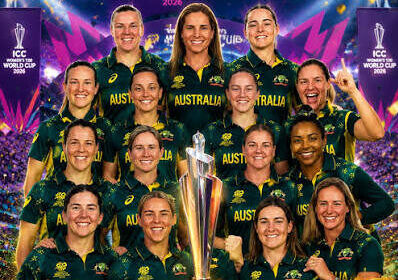
The Women’s T20 World Cup 2026 wrapped up an intense, action-packed three weeks of cricket across England. Twelve elite international teams battled for the ultimate crown, culminating in a spectacular grand finale at Lord’s. In the end, the powerhouse Australian squad proved entirely unstoppable, dismantling host nation England to capture their record-extending seventh global title.
Here are the complete results, knockout summaries, and final standings from this historic tournament.
Elite Semi Final and Final Knockout Results
The business end of the Women’s T20 World Cup 2026 delivered high-pressure matches that captivated global audiences, culminating in a historic final at the home of cricket.
June 30, 2026 – Semi Final 1: Australia vs West Indies (The Kia Oval, London) – Australia won by 8 wickets.
July 2, 2026 – Semi Final 2: England vs South Africa (The Kia Oval, London) – England won by 40 runs.
July 5, 2026 – The Final: Australia vs England (Lord’s Cricket Ground, London) – Australia won by 7 wickets.
Invincible Australia Outclass England at Lord’s to Claim Seventh Title
The grand finale of the tournament took place on July 5, 2026, before a record crowd of more than 28,000 spectators at Lord’s Cricket Ground. Australia demonstrated their complete dominance by securing an unprecedented seventh T20 World Cup crown, defeating host nation England by seven wickets with an incredibly clinical performance.
Choosing to bowl first under ideal conditions, the Australian bowling unit, marshaled by skipper Sophie Molineux, put on a masterclass of discipline and tactical awareness. They struck early, dismissing both English openers before the conclusion of the powerplay. Rising star Lucy Hamilton claimed her maiden World Cup breakthrough by dismissing Amy Jones in the second over, while Annabel Sutherland removed the dangerous Danni Wyatt-Hodge. England captain Nat Sciver-Brunt anchored a resilient recovery, compiling a gritty unbeaten 58. Partnering with Freya Kemp, who contributed a rapid 44 not out, Sciver-Brunt engineered an unbroken 80-run partnership for the fifth wicket, lifting England to a competitive total of 150 for 4 in their allotted 20 overs.
The subsequent run chase made a mockery of what would have been a record target in a global final. The legendary Beth Mooney marshaled the Australian reply with a masterful 64 off 49 deliveries. Mooney received superb specialized support from Phoebe Litchfield, who compiled a fluent 48. Displaying absolute composure, the Australian top order dismantled the English bowling variations with ease, overhauling the target in just 17.1 overs to finish at 153 for 3. This seven-wicket victory completed an entirely undefeated campaign for Australia. For her match-winning knock, Mooney earned the Player of the Match accolade and was additionally honored as the Player of the Tournament, finishing the campaign with 238 runs.
Semi Final Knockout Summary
The road to the Lord’s final was defined by two decisive victories at The Kia Oval, where both Australia and England showcased their superior form to secure their championship berths.
Semi Final 1 (June 30): Australia cruised to an eight-wicket victory over the West Indies. After restricting the Caribbean side to a modest 125/7—with Ashleigh Gardner (2/13) leading a disciplined bowling effort—Australia reached the target in just 13 overs. Beth Mooney anchored the chase with an unbeaten 61.
Semi Final 2 (July 2): England defeated South Africa by 40 runs to join Australia in the final. Batting first, England posted a formidable 169/5, largely driven by an outstanding all-round performance from Nat Sciver-Brunt. In reply, the Proteas were limited to 129/8, as the English bowling attack successfully defended their total to seal a home-ground final appearance.
Group Stage Tournament Record and Global Campaign Analysis
The path to the London knockouts demanded an extensive group phase across venues like Manchester, Bristol, and Leeds. This expanded twelve-team format amplified the physical and mental toll on every international squad, requiring deep rosters to navigate the opening weeks of the competition.
Several emerging nations displayed massive strides in technical development, creating highly volatile qualification metrics until the final deliveries. Squads that adapted quickly to shifting surface conditions between the faster northerly pitches and the turning tracks of the south found immediate rewards, while teams slow to alter their baseline strategies faced early elimination from this global showpiece.
Despite missing out on the final, individual excellence shone through the tournament. England’s opening batter Danni Wyatt-Hodge finished as the leading run-scorer of the competition, amassing 302 runs at an exceptional average of 60.40, including a magnificent century against Sri Lanka.
Final Group Standings Charts
Group 1
| Team | Matches | Won | Lost | Points | NRR |
| Australia (Q) | 5 | 5 | 0 | 10 | +3.882 |
| South Africa (Q) | 5 | 4 | 1 | 8 | +0.633 |
| India | 5 | 3 | 2 | 6 | +1.718 |
| Bangladesh | 5 | 2 | 3 | 4 | -0.710 |
| Pakistan | 5 | 1 | 4 | 2 | -1.872 |
| Netherlands | 5 | 0 | 5 | 0 | -3.276 |
Group 2
| Team | Matches | Won | Lost | Points | NRR |
| England (Q) | 5 | 5 | 0 | 10 | +2.342 |
| West Indies (Q) | 5 | 4 | 1 | 8 | +0.008 |
| Sri Lanka | 5 | 3 | 2 | 6 | -0.725 |
| New Zealand | 5 | 2 | 3 | 4 | +0.122 |
| Scotland | 5 | 1 | 4 | 2 | -0.232 |
| Ireland | 5 | 1 | 4 | 2 | -1.277 |